The Chess Grandmasters Behind Deep Blue
What a 1997 chess match says about building AI for customer experience. Deep Blue didn't beat Kasparov on compute alone. It won because grandmasters encoded their expertise into the machine.
What a 1997 chess match says about building AI for customer experience
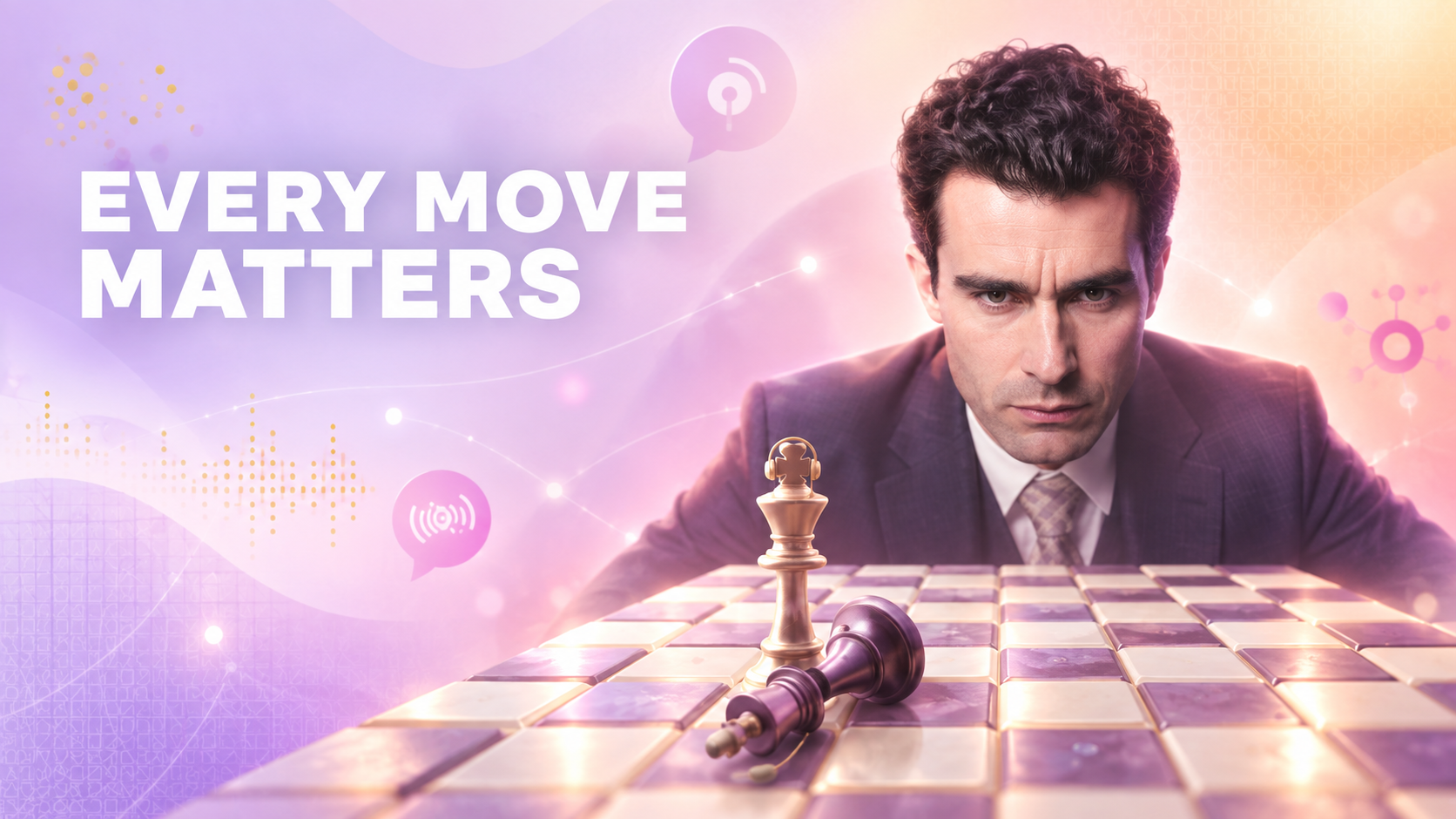
In May 1997, IBM's Deep Blue beat Garry Kasparov 3.5–2.5 in a six-game match in New York. It was the first time a computer had defeated a reigning world champion under tournament conditions, and it is still told as a story about raw compute: a machine evaluating 200 million positions per second finally out-calculating the best human alive.
That version of the story is wrong, or at least badly incomplete. If you've watched Rematch, the recent series dramatizing the match, you'll have seen the more interesting version. Deep Blue wasn't just a faster calculator. It was a machine that had been taught, painstakingly, by people who understood the game at the deepest level.
Compute wasn't the difference
Kasparov had beaten the previous version of Deep Blue 4–2 a year earlier in Philadelphia. The hardware got faster between matches, but that wasn't what changed the outcome. What changed was who was in the room.
IBM brought grandmaster Joel Benjamin onto the team full time. Other grandmasters, including Miguel Illescas, Nick de Firmian, and John Fedorowicz, consulted along the way. Their job wasn't to write code. It was to encode chess understanding into the machine: tuning the evaluation function so it valued positions the way a strong player does, building an opening book tailored to Kasparov's repertoire, and preparing responses to the lines he was most likely to play.
The payoff was visible on the board. In Game 2, Deep Blue declined a material grab that a "calculating" engine would have taken, and instead played a quiet positional move. Kasparov was so unsettled by how human it looked that he resigned a position later shown to be drawable. In the decisive Game 6, he walked into a known knight sacrifice in the Caro-Kann that the grandmasters had prepared in the opening book. The match was decided less by search depth than by domain expertise, codified.
There's a psychological layer too. Kasparov spent much of the match trying to read the machine's intentions, and the team's decisions about what to reveal, and when, shaped his play as much as any move on the board. Whether or not you accept every dramatized beat in Rematch, the underlying point holds: the machine won because expert humans shaped what it knew, what it valued, and how it presented itself to the opponent.
The same applies to customer experience
The CX industry is in its own Philadelphia moment. Vendors are shipping large language models into contact centers on the assumption that a sufficiently capable model, given enough context, will handle customer interactions well. Many of those deployments are producing the AI equivalent of a 1996 result: impressive in demos, beaten in production.
The reason is the same one IBM ran into. A general-purpose model doesn't know what a good outcome looks like in a specific contact center. It doesn't know that first-contact resolution and handle time trade off differently for a DMV renewal than for a telco billing dispute. It doesn't know when to hand off to a human, what a regulator will ask to see, how to score a conversation for quality, or which of the fifteen things a customer said actually matters. That knowledge lives in people who have spent careers running, measuring, and fixing contact centers.
This is the premise behind Trusst's Customer Experience Operating System. We are not trying to out-compute the foundation model providers; we use their models, and we stay neutral across them. What we build is the layer that encodes CX expertise into the system: how interactions are routed and orchestrated, how quality is measured across every channel and vendor, how agents are governed, and how the whole thing improves from its own outcomes. Our team combines decades of contact center operations and CX design with deep AI and ML engineering, and the product is what happens when those two disciplines sit in the same room the way Benjamin sat with Deep Blue's engineers.
What "codified expertise" looks like in practice
It shows up in mundane places. In an evaluation model that scores conversations the way an experienced QA lead would, not the way a generic rubric does. In routing logic that understands the cost of a bad transfer. In a customer simulator that stress-tests an agent against the awkward, adversarial, and confused calls that real populations generate at scale. In deployments that run inside the customer's own cloud because regulated organizations need to own their data and their models, not rent them.
None of this is glamorous, and none of it comes from a bigger model. It comes from knowing the game.
Deep Blue's engineers could have kept buying faster chips. They won by hiring grandmasters. The organizations that get durable results from AI in customer experience will be the ones that recognize the same thing: the model is the compute, and the expertise is the advantage.
Heading 1
Heading 2
Heading 3
Heading 4
Heading 5
Heading 6
Lorem ipsum dolor sit amet, consectetur adipiscing elit, sed do eiusmod tempor incididunt ut labore et dolore magna aliqua. Ut enim ad minim veniam, quis nostrud exercitation ullamco laboris nisi ut aliquip ex ea commodo consequat. Duis aute irure dolor in reprehenderit in voluptate velit esse cillum dolore eu fugiat nulla pariatur.
Block quote
Ordered list
- Item 1
- Item 2
- Item 3
Unordered list
- Item A
- Item B
- Item C
Bold text
Emphasis
Superscript
Subscript